Category: Answer Engine Optimization

Uses the primary industry term to capture “Top of Funnel” authority queries.

  • Positional Bias and Entity Extraction for AEO in SEO

    TL;DR: The Business Bottom Line

    Mastering AEO in SEO requires isolating the exact mathematical relationship between your native search rank and how generative engines extract your brand data.

    • The Core Reality: Ranking first on traditional search engine results pages guarantees the artificial intelligence models will ingest your factual data, but it mathematically fails to guarantee an explicit product recommendation.
    • The Revenue/Visibility Impact: Securing the top search position increases factual entity visibility by 4.3 percent over lower results, yet the explicit endorsement rate remains entirely flat across the top five search positions.
    • The Strategic Pivot: Marketing leaders must split their search strategy into distinct factual indexing and product endorsement tracks, shifting resources to secure placements within highly ranked software blogs over lower ranking legacy institutional sites.

    Note: The remainder of this report details the exact statistical methodology, causal inference models, and raw data used to reach these conclusions. It is written for data scientists, machine learning engineers, and technical search professionals.


    The Core Problem & Hypotheses

    As Generative AI systems mediate information retrieval, search visibility metrics require strict empirical reevaluation. We tested whether a high native search rank compels a Large Language Model to extract entities or recommend products at a higher frequency.

    We pre-registered and tested two formal hypotheses within a Google Vertex AI Search configuration:

    H2A (Factual Extraction): Generative AI architectures enforce a positional bias during extraction, such that $P(\text{extracted} \mid \text{Rank 1}) > P(\text{extracted} \mid \text{Rank } k)$, where $k$ represents lower ranked evidence.

    H2B (Recommendation Propensity): Entities sourced from Rank 1 hold a statistically higher probability of explicit recommendation, such that $P(\text{recommended} \mid \text{Rank 1}) > P(\text{recommended} \mid \text{Rank 3 to 5})$, controlling for source text brand density.

    Experimental Setup & Methodology

    Data aggregation relied on grounded conversational outputs across thousands of financial logic queries. To ensure tracking accuracy, we enforced a strict Closed-World Assumption. The pipeline mapped evidence URLs to canonical domains and tracked only the entities strictly traceable to the provided grounding sources.

    We evaluated entity extraction using a robust four layer funnel to prevent false negatives:

    • Regex Matching: Exact string matching of brand names in the generated response.
    • spaCy NER: Implementation of the en_core_web_sm model with a custom EntityRuler injected with a specialized brand dictionary to capture ORG and PRODUCT classifications.
    • Dictionary Lookup: Mapping localized product strings back to their parent canonical domains.
    • LLM Implicit Extraction: A fallback evaluation using gemini-3.1-pro-preview to identify implicit non-named entity references based strictly on context.

    To prevent confounding variables where top pages simply repeat their brand names to manipulate extraction, we engineered a Position-Weighted Brand Density control.

    Mentions of an entity in the first 20% of the text received a 2.0x weight, and mentions in the top 50% received a 1.5x weight.

    Isolating the Variables: Our Statistical Approach

    We applied causal inference models to isolate the genuine effect of ranking position over simple correlation.

    We corrected all final outputs for multiple hypothesis testing using the Benjamini-Hochberg procedure.

    Statistical TestVariable IsolatedRationale for Selection
    Logistic RegressionPosition-Weighted Brand DensityResidualizes hit rates by modeling $P(\text{mentioned} \mid \text{rank, brand\_density, cluster, intent})$.
    Cluster-Aware Block PermutationQuery-Level VarianceShuffles rank labels strictly within identical query clusters to account for localized intent variance.
    Propensity Score Matching (PSM) & IPWCausal Effect of PositionIsolates the causal effect of search ranking position from confounding text variables.

    Key Empirical Findings for AEO in SEO

    Finding 1: The Positional Bias in Factual Extraction (H2A)

    Analysis of the raw and controlled entity hit rates confirms a severe rank gradient for factual ingestion. The raw hit rate for Rank 1 sources sits at 11.9% ($n = 1645$).

    This decays sequentially.

    Rank 2 sits at 11.8% ($n = 1233$), Rank 3 through 5 falls to 9.9% ($n = 1840$), and Rank 6 and above drops to 7.6% ($n = 720$).

    Applying the logistic control yields a 12.5% controlled hit rate for Rank 1 versus 8.5% for Rank 6 and above.

    The 95% Confidence Intervals for Rank 1 [9.3%, 12.9%] and Rank 6 and above [4.0%, 9.6%] do not overlap.

    This demonstrates robust statistical significance and supports H2A.
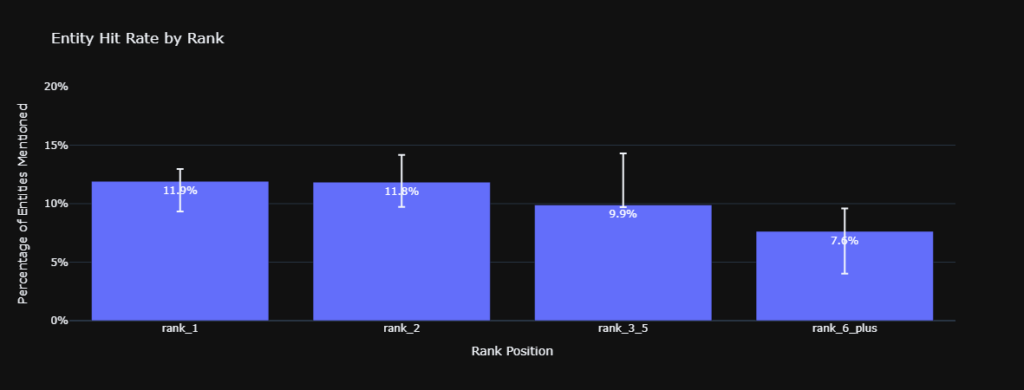
    Document level AEO in SEO entity hit rate by source rank bin demonstrating positional bias.
    Document-level Entity Hit Rate by Source Rank Bin. Error bars denote 95% Confidence Intervals for the sample means, demonstrating non-overlapping variance between top positions and lower tiers.

    Finding 2: Intent Context Alters Positional Bias for AEO in SEO

    Stratification of the dataset reveals that user intent contextually overrides positional bias. Within the commercial cash_flow cluster, Rank 1 achieved a 25.2% hit rate.

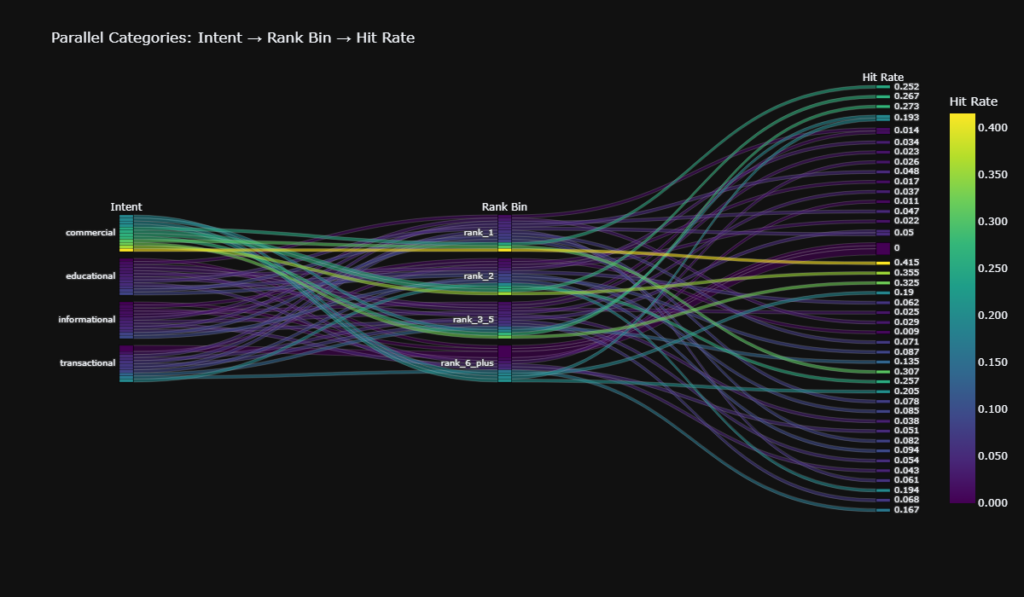
    However, Rank 2 achieved 26.6%, and Ranks 3 through 5 secured 27.3%. In high-value commercial evaluations, the LLM actively diversifies its sourcing across the primary search window, displaying contextual rank agnosticism.
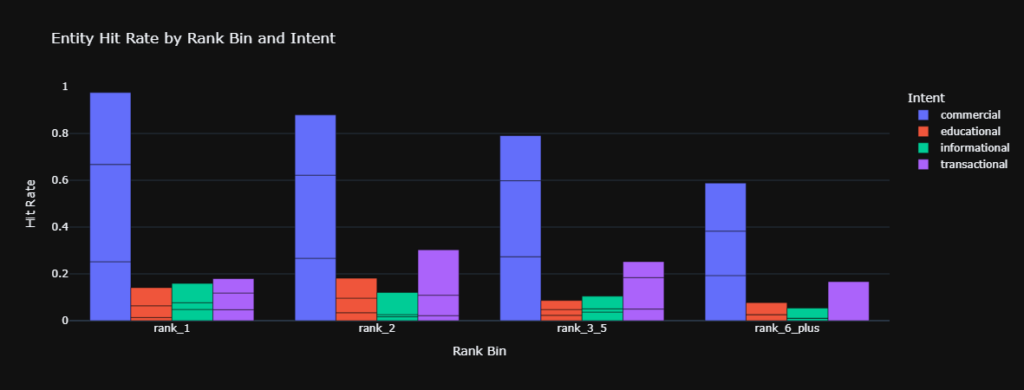
    Grouped bar chart tracking AEO in SEO entity hit rate across rank bins stratified by user intent
    Grouped bar chart tracking Entity Hit Rate across Rank Bins, stratified by User Intent. The data illustrates how commercial intents disrupt the standard rank decay curve for AEO in SEO.
    Parallel categories plot visualizing commercial query flow and AEO in SEO extraction density.
    Parallel Categories plot visualizing the commercial flow, depicting high density hit rates converging tightly across Ranks 1 through 5

    Finding 3: The Decoupling of Recommendation Propensity (H2B)

    We utilized a zero-temperature LLM prompt requiring JSON output to map recommended entities to exact sections and text quotes.

    This tested whether factual extraction translates into explicit recommendation propensity for AEO in SEO.

    The probability metric $P(\text{recommended} \mid \text{rank})$ is non-monotonic and structurally low:

    • Rank 1: 0.015 ($n = 1225$)
    • Rank 2: 0.013 ($n = 910$)
    • Rank 3 through 5: 0.016 ($n = 1362$)
    • Rank 6 and above: 0.003 ($n = 591$)

    A two-tailed T-test comparing Rank 1 and the Rank 3 through 5 cluster yielded a p-value of 0.571. This establishes no statistical difference. Search position does not reliably scale recommendation likelihood, meaning H2B is not supported.
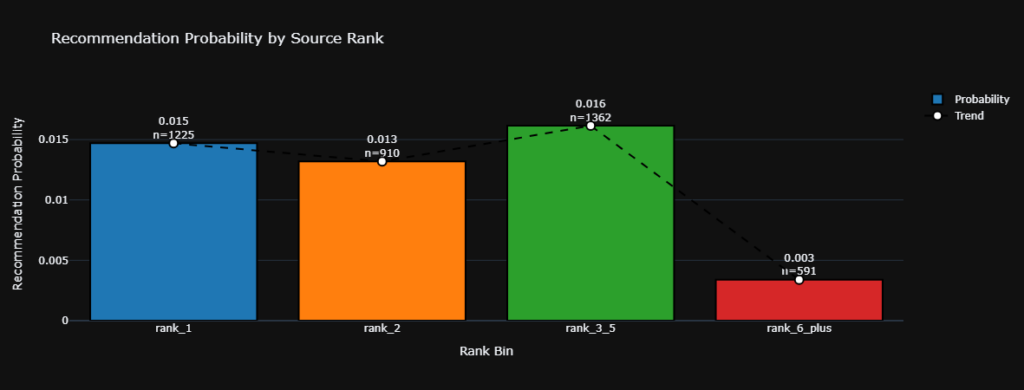
    Recommendation probability by rank bar and scatter plot showing decoupling of rank and endorsement for AEO in SEO.
    Bar and scatter plot visualizing Recommendation Probability by Rank. The non-monotonic trend line illustrates the decoupling of search rank from the propensity to explicitly recommend an entity.

    Structural Impact

    The data exposes an Authority Erosion Effect native to LLM grounding mechanisms. The mean textual brand density measured 3.96 for Rank 1 sources, while Rank 6 and above sources exhibited the highest density at 4.31.

    A qualitative domain audit revealed Rank 1 is heavily populated by agile B2B software domains, whereas Rank 6 and above contains macro-financial institutions.

    Because the generative model enforces positional bias, it systematically ingests narratives from Rank 1 domains.

    This effectively circumvents the traditional extrinsic domain authority of the legacy institutions natively populating the lower ranks.

    Technical Glossary (Entity Mapping)

    • Closed-World Assumption: A strict data boundary premise where entity tracking is limited exclusively to the specific entities present within the provided grounding URLs.
    • Position-Weighted Brand Density: A statistical control metric that assigns mathematical weight multipliers to brand mentions based on their proximity to the beginning of a document.
    • Propensity Score Matching (PSM): A matching technique used to estimate the causal effect of a treatment by accounting for covariates that predict receiving the treatment.
    • Cluster-Aware Block Permutation: A variance control method that shuffles rank labels strictly within identical query clusters to isolate local intent effects.
    • Benjamini-Hochberg Procedure: A statistical method for controlling the false discovery rate during multiple hypothesis testing to ensure p-values reflect true significance.
    • Zero-Temperature Prompt: A deterministic Large Language Model parameter setting that forces the model to select the most probable token, eliminating creative variance during extraction.
    • Inverse Probability Weighting (IPW): A technique used to calculate statistics standardized to a pseudo-population to adjust for confounding variables in observational data.

    Frequently Asked Questions

    Q: How does search rank causally affect AEO in SEO?

    A: Search rank dictates the probability of factual extraction by generative models, creating a measurable mathematical bias toward the first position over lower results.

    Q: Does a top ranking statistically guarantee an AI brand recommendation?

    A: No, empirical data shows recommendation probability remains flat across ranks one through five, confirming a p-value of 0.571 and no statistical advantage.

    Q: What is the Authority Erosion Effect structurally?

    A: It is a phenomenon where generative models prioritize factual extraction from highly optimized software domains ranking first, circumventing the native authority of lower ranking legacy institutions.

    Q: Why did the study calculate position-weighted brand density?

    A: This metric controls for confounding variables where top ranking pages might artificially inflate their extraction rates by repeating their brand name more frequently than lower pages.

    Q: How do commercial intents alter baseline entity extraction rates?

    A: High-value commercial queries cause the language model to diversify its context window, flattening the positional bias across the top five search results.

    Q: What does a p-value of 0.571 prove regarding recommendation propensity?

    A: It confirms that the minor variances in recommendation rates between the first position and positions three through five are strictly due to random chance, not rank position.

      Conclusion

      The empirical data confirms that generative retrieval architectures actively enforce a positional bias during factual extraction, granting a statistically significant advantage to Rank 1 sources. However, rigorous causal inference testing reveals this positional bias fails to cascade into recommendation propensity. Search rank serves strictly as a gatekeeper for factual entity ingestion, operating completely independently of the underlying mathematical logic the model utilizes for explicit brand endorsement.

      Kojable

      Kojable tracks how artificial intelligence models cite brands across different user personas and commercial intent clusters. If you are optimizing for AI search, we can show you exactly how your content performs in live retrieval.
    1. The Answer Engine Optimization Rank 1 Myth

      TL;DR

      We studied 1500 generated answers to see how answer engine optimization works in reality. We found that securing the top source controls what the model writes first, but it does not force identical outputs. Winning top placement gets you credit without locking the artificial intelligence into a single narrative.

      The hypothesis

      Founders and marketing leaders need to know if holding the top spot forces the model to copy their exact story. We tested two main ideas to understand this behavior.

      Our first idea checked if answers sharing the top source look identical.

      Another idea tested if that top source controls specific sections inside the text.

      Why this matters

      Search is changing fast. Answer engine optimization focuses on getting your content understood and surfaced by artificial intelligence. Generative engine optimisation improves your representation inside chat answers.

      A system connects an external database to the language model so it can retrieve facts before writing. You will miss what actually drives the output if your tracking software only looks at link placement.

      Data science helps us separate who gets cited from what the user eventually sees.

      The methodology

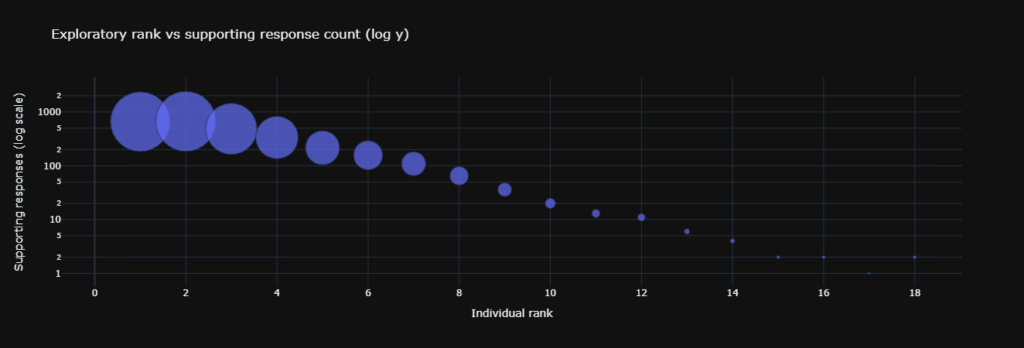
      We built a dataset of 1500 generated responses. These responses contained 3797 grounding rows from 1171 unique sources. Our team split every generated answer into smaller sections. We then divided the original sources into text chunks.

      The researchers embedded both parts and matched the sections to the closest chunks using mathematical distance. We tracked citation counts to see where the model paid attention. The top spot received 1171 citations, while the tenth spot only received 23 citations.

      Statistical approach

      Our team used bootstrap confidence intervals with 2000 resamples. This method estimates uncertainty without assuming our data follows a normal curve. Researchers also ran permutation tests with 3000 shuffles.

      This created a clean baseline to show what happens if we mix up all the source labels randomly. The final report included the effect size so your business decisions rely on actual impact rather than simple probability scores.

      Key findings

      The first test showed no support for identical outputs.

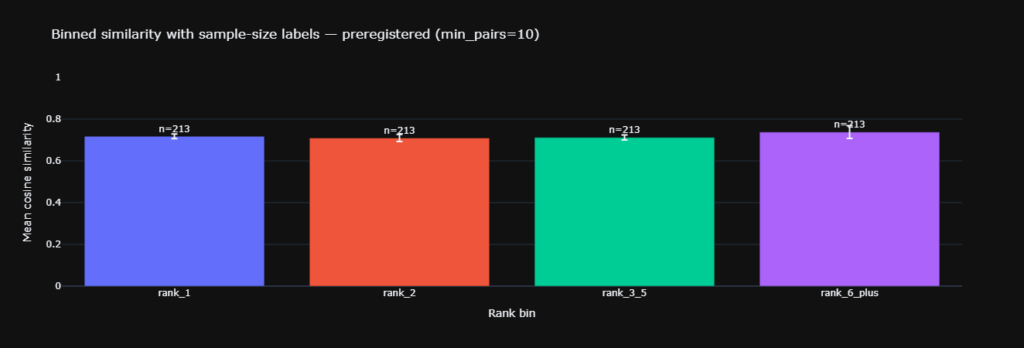
      1. Similarity scored 0.717 for the top shared pairs and 0.712 for lower shared pairs.
      Bar chart with Rank 1 and Rank 3 to 5 bars at nearly the same height illustrating answer engine optimization.
      Cross response similarity stays almost flat across shared source rank bins.

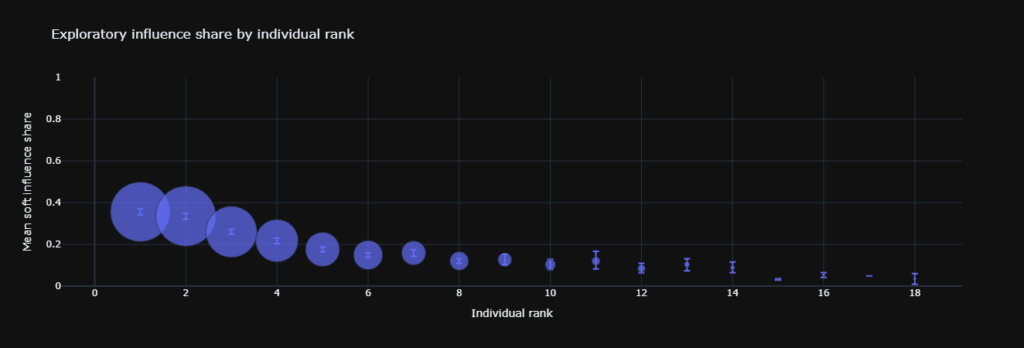
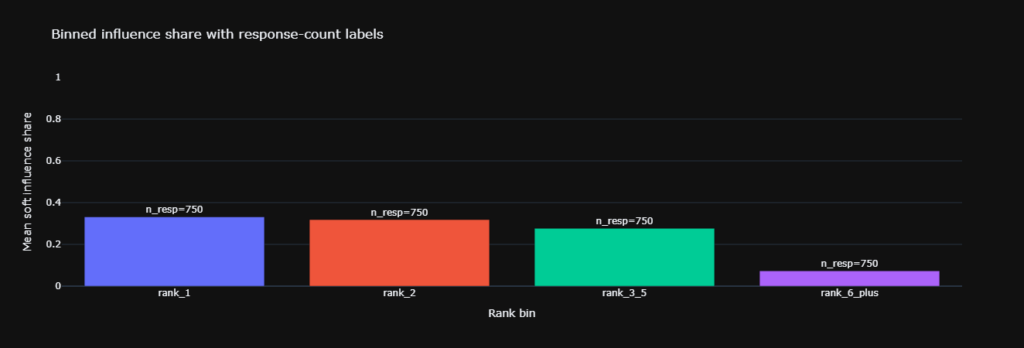
      2. The second test proved the top source dominates internal sections. Top influence share reached 0.38 compared to a 0.25 baseline.

      Bar chart where Rank 1 is tallest and Rank 6 plus is smallest showing answer engine optimization impact.
      Within one answer Rank 1 wins a larger share of section influence than any other bin.

      3. Top influence drops significantly as you move down the list.

      Scatter plot with larger points at low ranks and smaller points at high ranks for answer engine optimization analysis.
      Mean influence share declines as rank increases.

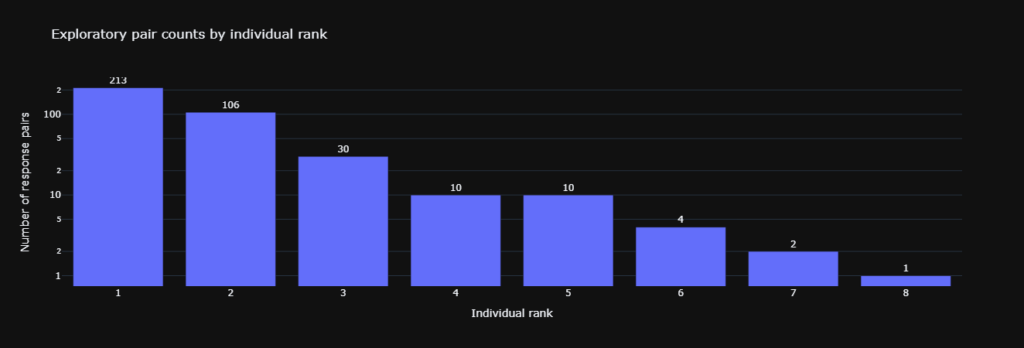
      4. The amount of available data falls fast beyond the first few positions.

      Bar chart with a tall bar at Rank 1 and much shorter bars by Rank 8.
      The number of response pairs per shared rank drops sharply after the first few ranks.

      5. Citation counts show a steep drop in model attention.

      Bubble chart on a log scale where bubbles shrink as rank increases.
      Supporting response counts drop as rank increases showing top heavy citing behavior.

      Impact on results

      Looking only at citation counts makes you think this process is just a simple race to the top. Influence share metrics and shuffle tests change that perspective completely. The top spot dominates the internal structure of the text.

      However, that shared source does not make the final answers converge across different prompts. This provides a cleaner way to evaluate artificial intelligence behavior.

      We can finally separate internal attribution from external similarity.

      What this means for you

      You should aim for the top position whenever possible. That first spot tends to anchor the early sections of the generated text. Teams must also cover the next few positions with specific pages.

      The model blends multiple sources together so cross answer similarity stays diverse. Use data science to track influence share by web address.

      Tune your AEO tool to report both retrieval rate and section influence. Add intent mapping to your testing process.

      Check which intents show up as influential chunks across the final output.

      Key Terms Glossary

      • Cosine similarity is a score that measures how close two embedding vectors point.
      • Bootstrap confidence interval is a range built by resampling the observed data many times.
      • Permutation test is a shuffle based test that compares the observed effect to effects from randomized labels.
      • Cohen d is an effect size that expresses mean differences in standard deviation units.
      • Null model is a baseline world used for comparison.

      Frequently asked questions

      FAQ 1

      Does the top spot make artificial intelligence answers the same.

      No, because similarity remains flat across different ranks.

      FAQ 2

      Does the top spot still matter for answer engine optimization.

      Yes, because it shapes many sections inside the generated text.

      FAQ 3

      What should my team measure in their tracking software.

      Track retrieval by position and influence share by web address.

      FAQ 4

      How do I explain this to a non technical team.

      The top source sets the opening and gets most of the credit, but the full answer still changes with the prompt.

      FAQ 5

      Where does intent mapping fit into this process.

      Use it to define the questions you want to own and measure if those intents appear in influential sections.

      Summary

      The top rank wins influence inside answers without forcing sameness, so your strategy should pair ranking work with section level measurement.

      Follow Kojable for more deep dives

    2. What G2 Data Reveals About the GEO/AEO Tool Landscape?

      I analyzed G2 data for 23 AEO platforms to see who is really buying, using, and reviewing these tools. Here’s what the numbers reveal about market saturation, persona dominance, and whitespace opportunities.

      1) Market segment: where the fight is hottest

      The Small-Business segment is crowded, with many competitors showing 60%+ SB concentration. Some vendors are entirely SB-dependent: Visby AI (91%), Hall (92%), AI clicks (88%), SE Ranking (89%), and even major names like Semrush (62%) and Ahrefs (62%).

      Implication: If you’re launching an AEO tool for small businesses, you’re entering the most saturated segment. To win, you need extreme ease-of-use (self-serve, zero onboarding), aggressive pricing (freemium or sub-$99/mo), or a hyper-specific niche like “AEO for local service businesses.” Generic “AI visibility for SMBs” won’t cut it.

      At the Enterprise end (35%+ concentration), fewer players compete, and a smaller group balances Enterprise/Mid-Market. This split creates distinct “lanes” (SMB-first, MM-first, Enterprise-first), each with different expectations for onboarding, security/compliance, reporting depth, and customer success.

      2) Personas: practitioners dominate, but execs are emerging

      The most frequently targeted roles skew toward SEO and marketing practitioners:

      • SEO Manager (5 vendors)
      • Marketing Manager (4 vendors)
      • Digital Marketing Manager / SEO Specialist (2 each)

      However, CEO/Founder/Owner appear as primary users for Profound, Visby AI, Ahrefs, and SE Ranking—suggesting these tools are either simple enough for non-specialists or packaged as high-level strategic reporting.

      Implication: Most platforms are built for doers (SEO teams executing daily). But there’s a second motion: dashboards so clean that a CEO can answer “Are we visible in AI search?” in 30 seconds. Serving both personas unlocks budget authority and daily stickiness. If your product requires expert workflows, lean into “built for practitioners.” If it’s narrative/visibility risk + decision support, position it as “built for leadership.”

      3) Industry focus: concentration creates whitespace

      70% of competitors focus on Marketing & Advertising (12 vendors), Computer Software (6 vendors), and IT Services (3 vendors). This density provides clear ICP fit but also creates opportunities where competitive noise is lower.

      Underserved industries:

      • Financial Services (only Yext)
      • Healthcare (only Yext)
      • Retail (3 vendors, not primary)
      • Consumer Services (only Conductor)

      Implication: An AEO platform specifically built for regulated industries (Finance, Healthcare, Legal) or product-heavy sectors (Retail, CPG) would face minimal direct competition. The wedge: “We understand your compliance needs / product catalog structure / seasonal volatility.”

      4) The biggest insight: a major data gap

      A meaningful portion of competitors have “No information available” for Users (and some for Industries). This creates strategic risk—conclusions about persona saturation and category positioning become biased toward companies with better-populated profiles.

      Action item: Fill these gaps with external research: product pages, case studies, job postings, sales decks, onboarding flows, customer logos, and review mining beyond G2 snapshots.

    3. AEO/GEO Pricing Intelligence: What You Can Afford to Pay

      A vendor manager’s guide to AI Search Optimization budgets, ROI thresholds, and platform selection


      The Bottom Line for Budget Owners

      If you’re managing AEO/GEO vendor selection, here’s your decision framework: Don’t pay more than you can justify in measurable search visibility ROI within 12 months.

      With platforms now competing across freemium to custom enterprise tiers, overpaying is a bigger risk than underpowering.

      Current Entry Floor: $39–$99/month
      ROI Justification Zone: $150–$399/month for most mid-market organizations
      Enterprise Threshold: $500+/month only if you have multi-brand complexity or compliance requirements


      Budget Tier Analysis: What You Get vs. What You Should Pay

      Tier 1: Proof-of-Concept / Solopreneur ($0–$99/month)

      Who should buy: Startups validating AEO need, individual consultants, agencies testing tools for client recommendations

      Price PointWhat to ExpectROI RealityExample Vendors
      Free–$491–2 AI engines, basic tracking, 1 projectBreak-even on time savings onlyAirOps (start for free),
      Hall Lite (free, 1 project), Geneo (free tier + Pro at $39.9),
      Geordy (entry usage-based credits)
      $50–$992–4 engines, 5–10 articles/month, competitor monitoringJustifiable if it saves 2–3 hours/week of manual search auditingWritesonic Lite ($49), Jasper Pro ($59),
      Cognizo Monitor ($89), Promptwatch Starter ($99),
      Profound Starter ($99),
      Scrunch Explorer ($100)

      Vendor Manager Play: Treat this as a trial tier. If a vendor can’t demonstrate measurable visibility lift within 60 days at this price, they won’t deliver at higher tiers.

      Red flag: Any platform without content generation bundled here will be obsolete by Q4 2026.

      Freemium Risk Warning: AirOps and Hall Lite offer unlimited free tiers—sustainable only if 5–10% convert to paid. If you’re staying on free forever, expect feature limits or sunsetting.


      Tier 2: Departmental Deployment ($150–$399/month)

      Who should buy: Marketing teams at $5M–$50M revenue companies, growth agencies managing 3+ clients

      This tier is the most saturated segment. Differentiation is non-technical (support quality, onboarding, agent features).

      Price PointJustification MathRisk AssessmentExample Vendors
      $150–$199Must deliver equivalent of 1–2 days/month of analyst time savings + measurable ranking improvementsHigh churn zone—vendors compete on features, not outcomesOtterly Standard ($189), AIclicks Pro ($189),
      Hall Starter ($199), Writesonic Professional ($249)
      $200–$299Should include content automation, multi-engine coverage, team collaboration (3+ seats)Sweet spot for ROI—platforms here have enough functionality to show real workflow impactPromptwatch Professional($249),
      $300–$399Requires either: (a) execution agents, (b) compliance features, or (c) agency-level multi-client managementIf it doesn’t include agents/automation, you’re overpayingGeordy Business ($399)
      Profound Growth ($399),
      Cognizo Optimize ($399),
      Open Forge Startups($349)

      Critical Insight: At $200–$299, switching costs become your friend. Once a team is trained and data is accumulated, migration pain exceeds the savings from downgrading to a $99 competitor. Negotiation leverage: Push for annual prepay discounts (typically 15–20%—Hall offers 16%, AIclicks 17%, Writesonic 20%).


      Tier 3: Enterprise / Multi-Brand ($500–$12,000+/month)

      Who should buy: Enterprise brands with complex governance, regulated industries, agencies managing 10+ clients

      Price PointWhen It’s JustifiedWhen It’s NotExample Vendors
      $500–$799Self-serve enterprise with unlimited seats, API access, custom reportingIf you need heavy customization but the vendor charges for “managed services” without delivering strategic valueTelepathic Pro ($475),
      AIclicks Business ($499),
      Scrunch Growth ($500),
      Promptwatch Business ($549),
      Share of Model ($799)
      $1,000–$3,499Custom integrations, dedicated success management, outcome-based pricingPure monitoring with a high price tag—platform features will commoditize this within 18 monthsOpen Forge Midmarket ($1,999),
      Yolondo Growth ($3,499)
      $3,499–$10,000+Done-for-you execution, guaranteed rankings, agency staffing augmentationYou’re paying for labor, not software—benchmark against hiring in-house talentOpen Forge Managed ($3,999),
      Alex Groberman Enterprise ($9,999),

      Vendor Manager Rule: Above $1,000/month, demand published case studies with comparable companies.

      Platforms like ChatRank, SaaSRank and Withgauge hide pricing—this creates procurement friction and often signals sales-driven complexity rather than value clarity.


      Pricing Model Selection for Procurement

      Your GTM StrategyBest Pricing ModelWhy It WorksVendors Using This Model
      Organic growth, limited budgetTransparent flat-ratePredictable costs, no overage surprises, easy budget approvalHall (16% annual discount),
      Cognizo (17%, 2 months free),
      Rapid scaling, uncertain usageFeature-led hybridFlexibility, but requires strict usage monitoring to avoid budget creepAIclicks (hybrid: engines + blogs + prompts), Writesonic (articles + seats + GEO), Promptwatch (sites + prompts + articles), Scrunch (users + prompts),
      ZipTie (searches + optimizations),
      Otterly (prompts + audits), Geordy (usage-based credits),
      Geneo (credit-based)
      Enterprise sales, complex requirementsCustom/Outcome-basedAligns vendor incentives with your results, but requires robust SLA definitionsOpen Forge Managed, Alex Groberman Labs, SaaSRank, Petra Labs, Share of Model, Withgauge, ChatRank

      Procurement Warning: Hybrid models often create “overage shock” at month-end.

      AIclicks, Writesonic, Promptwatch, Scrunch, and ZipTie all use multi-dimensional pricing—cap monthly spend or negotiate unlimited tiers if you have variable content needs.

      Geordy and Geneo use credit-based systems that require careful burn monitoring.


      ROI Calculation Framework for Vendor Managers

      Use this formula to determine your maximum justifiable spend:

      Monthly Platform Cost ≤ (Monthly Value of Time Saved) + (Estimated Revenue Impact from Visibility Gains)

      Component A: Time Savings Valuation

      • Manual AI search auditing: 4–8 hours/week for a mid-market brand
      • Loaded cost of marketing analyst: $75–$125/hour
      • Monthly value of automation: $1,200–$4,000

      Component B: Revenue Impact

      • Conservative: 5–10% increase in qualified organic traffic from AI search
      • Average B2B conversion rate: 2–3%
      • Average deal size: Calculate your own

      Example Calculation

      If a platform saves 6 hours/week of analyst time ($4,500/month value) and generates 2 additional qualified leads worth $5,000 each:

      Maximum Justifiable Cost: $4,500 + $10,000 = $14,500/month
      Rational Ceiling for AEO Platform: $500–$1,000 (you’re paying for software, not total value capture)


      Vendor Differentiation by Use Case

      Instead of repeating the same names, here’s how specific platforms carve out positioning:

      Use CaseExample VendorsWhy Them
      Content-heavy teamsWritesonic (40–100 articles), AIclicks (10–30 blogs), Promptwatch (5–30 articles)Quantity + quality of AI-generated content bundled
      Execution agents (auto-publishing)Telepathic (AI strategy agent),
      Open Forge (unlimited agent usage)
      Automation beyond monitoring
      Agency multi-client managementHall Business (50 projects), Scrunch Growth (5 users, 700 prompts),
      Promptwatch Scale (5 sites, 350 prompts)
      Seat scaling + project segmentation
      Startup-friendly entryGeneo ($39.9 affordable multi-brand),
      ZipTie Starter ($69)
      Low friction, growth-path clarity
      Enterprise service-heavyOpen Forge Managed,
      SaaSRank,
      Alex Groberman Labs,
      Petra Labs
      Done-for-you execution, but verify outcome guarantees

      Market Trajectory: Lock in Pricing Now

      2026 Forecast:

      Monitoring will become table stakes, differentiation will shift to execution agents.

      Strategic Recommendation:

      • If buying in Q1–Q2 2026: Lock annual contracts at current $150–$250 rates.
      • Platforms like Hall, AIclicks, and Writesonic offer 16–20% annual discounts—you won’t see lower mid-market prices, and feature expansion will make these tiers more valuable.
      • If evaluating vendors: Prioritize platforms with agent/automation roadmaps (Telepathic, and Open Forge). Pure monitoring plays (ChatRank, Peec.ai) will be commoditized within 18 months.
      • If managing existing contracts: Renegotiate any $500+ monitoring-only contracts immediately. That pricing reflects 2024 market conditions, not 2026 realities.

      What to Avoid (Across All Platforms)

      Don’t pay for:

      • Generic monitoring without content generation (below $300 tier).
      • Hidden pricing without clear ROI demonstrationWithgauge, Petra Labs all obscure costs; demand transparency or walk away
      • “Enterprise” features you can replicate with $50/month tools + Zapier

      Do pay for:

      • Execution agents that automate publishing/optimization (Telepathic, Open Forge)
      • Proven case studies in your exact company size/category

      The 2026 AEO market is a buyer’s market below $300 and a value-validation challenge above $500.

      With 195+ platforms competing, you have leverage—use it to lock in rates before the next pricing compression cycle.