• AI Search Personalization: Do Results Actually Vary by Professional Role?

    Quick Answer: Yes, but the impact is strategic rather than overwhelming. AI does personalize search results based on professional roles, but it’s just one piece of the puzzle.

    • The Takeaway: Highly operational roles (like AR and AP managers) get highly tailored AI responses, whereas generalist roles (like finance analysts) receive much more generic outputs.
    • The Data: In a blocked permutation test of 988 finance prompts, we found effect sizes ranging from Cohen’s d = 0.48 to 0.95.
    • The Reality Check: While 72% of this personalization survives even when we strip out role-specific jargon, persona only accounts for about 5% of the total response variance. Intent, topic, and industry context are still the heaviest hitters.

    What This Research Examined

    We tested whether AI search engines genuinely adapt content to professional personas or simply echo job titles back. Specifically: when a CFO and an AR manager both search for cash flow guidance with the same underlying intent, does the AI produce substantively different answers?

    Sample: 988 prompts across 12 B2B finance personas (~82 per role) Method: Blocked permutation tests with vocabulary ablation controls Significance: All findings p < 0.002 unless noted


    Key Findings: AI Persona Personalization by the Numbers

    FindingMetricInterpretation
    Persona-response correlationr = 0.22 (r² = 0.048)Small-to-medium effect; 5% variance explained
    Within-persona similarity premium+0.062 cosine similarityResponses to same role cluster measurably
    Effect after jargon removal72% of signal survivesSubstantive adaptation, not vocabulary echoing
    Strongest persona effectCohen’s d = 0.95 (AR manager)Very large differentiation
    Weakest persona effectCohen’s d = 0.48 (finance analyst)Medium effect; overlaps with other roles

    Confidence intervals: ±0.16 for Cohen’s d estimates (95% level)
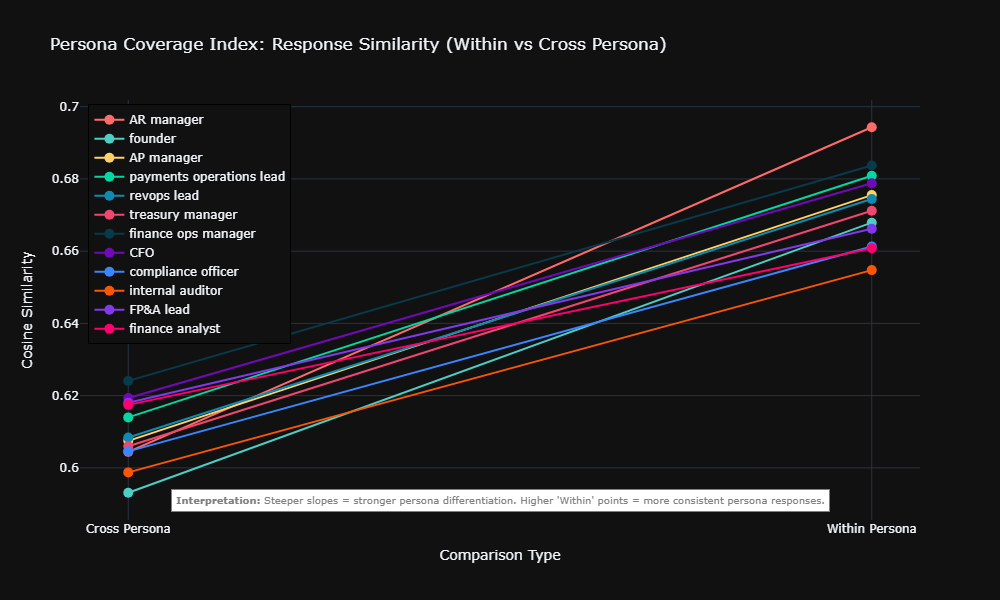
    Figure 1: Persona Coverage Index. The upward slopes confirm that AI responses generated for the identical persona (Within Persona) have measurably higher cosine similarity than those generated across different personas (Cross Persona).
    Figure 1: Persona Coverage Index. The upward slopes confirm that AI responses generated for the identical persona (Within Persona) have measurably higher cosine similarity than those generated across different personas (Cross Persona).

    Does AI Actually Change Content or Just Word Choice?

    Common misconception: AI personalization is cosmetic—swapping job titles while delivering identical advice.

    Reality: Ablation testing proves substantive adaptation.

    We mathematically stripped all role names, industry jargon (“collections velocity,” “covenant compliance”), and professional vocabulary from responses, then re-measured similarity. The persona signal dropped 28%—from +0.062 to +0.045—but remained statistically significant (p = 0.002).

    What this means: The AI alters advice structure, prioritization, and strategic framing based on role context, not just surface language.
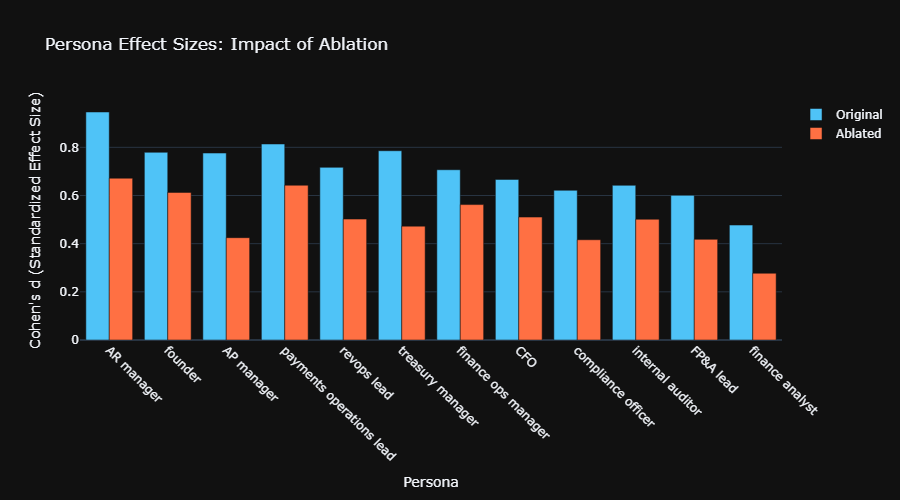
    Figure 2: Persona Effect Sizes (Original vs. Ablated). While removing role-specific vocabulary reduces the distinction, ~72% of the effect size remains intact, proving the AI alters substantive advice.
    Figure 2: Persona Effect Sizes (Original vs. Ablated). While removing role-specific vocabulary reduces the distinction, ~72% of the effect size remains intact, proving the AI alters substantive advice.

    Which Finance Roles Trigger the Most Distinctive AI Responses?

    Not all personas receive equal AI differentiation. Operational and risk-focused roles show strongest signal; generalist roles blur together.
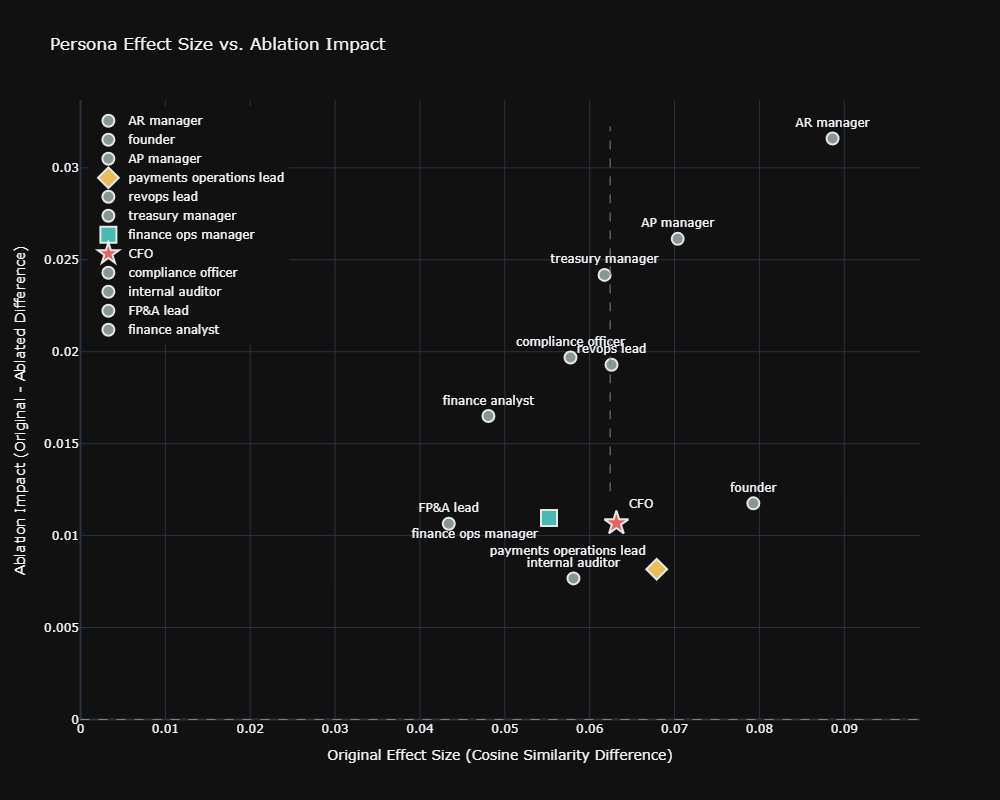
    Figure 3: Original Distinctiveness vs. Ablation Impact. Operational roles like AR Managers show high distinctiveness but rely heavily on jargon, whereas strategic roles like Founders maintain distinctiveness through broader strategic framing.
    Figure 3: Original Distinctiveness vs. Ablation Impact. Operational roles like AR Managers show high distinctiveness but rely heavily on jargon, whereas strategic roles like Founders maintain distinctiveness through broader strategic framing.

    High-Differentiation Roles (Cohen’s d > 0.75)

    RoleOriginal dAblated dWhy Distinctive
    AR manager0.95 [0.63, 1.27]0.68Specific operational metrics (DSO, collection targets)
    Payments ops lead0.81 [0.50, 1.14]0.65Technical payment systems focus
    Founder0.78 [0.46, 1.10]0.62Strategic/growth framing vs. operational
    AP manager0.78 [0.46, 1.10]0.48Vendor management, cash timing priorities

    Moderate-Differentiation Roles (Cohen’s d 0.50–0.75)

    • CFO, FP&A lead, compliance officer, internal auditor, finance ops manager, revops lead, and Treasury manager*.

    Low-Differentiation Role (Cohen’s d < 0.50)

    • Finance analyst: d = 0.48 [0.16, 0.80] original, 0.28 ablated

    Strategic implication: If your ICP is a finance analyst, persona-based AEO optimization delivers weak returns. Invest in industry vertical and use-case differentiation instead.

    *Note on Treasury Managers: While their final text responses show moderate differentiation, they actually trigger the highest distinctiveness of any role in backend search behavior (Query Fan-Out d = 0.95)**. The AI searches the web completely differently for them, even if the final text output is more constrained.


    How Does AI Tone Change for Different Finance Roles?

    Beyond content structure, AI adapts communication register measurably:

    FeatureLowestHighestPattern
    FormalityFounder (13.8)AP manager (16.1)Operations roles get formal register
    Analytical densityCompliance officer (4.0)FP&A lead (7.0)Planning roles get data-heavy content
    Urgency framingFounder (0.53)Compliance officer (1.13)Risk roles get alarm language
    SentimentCompliance officer (0.23)Finance analyst (0.67)Risk-averse roles get negative tone
    Directive voiceFounder (0.65)Internal auditor (1.04)Audit roles get imperative instructions

    Statistical basis: Kruskal-Wallis H-tests, p < 0.05 with Bonferroni correction; effect sizes small-to-medium (η² = 0.06–0.12)
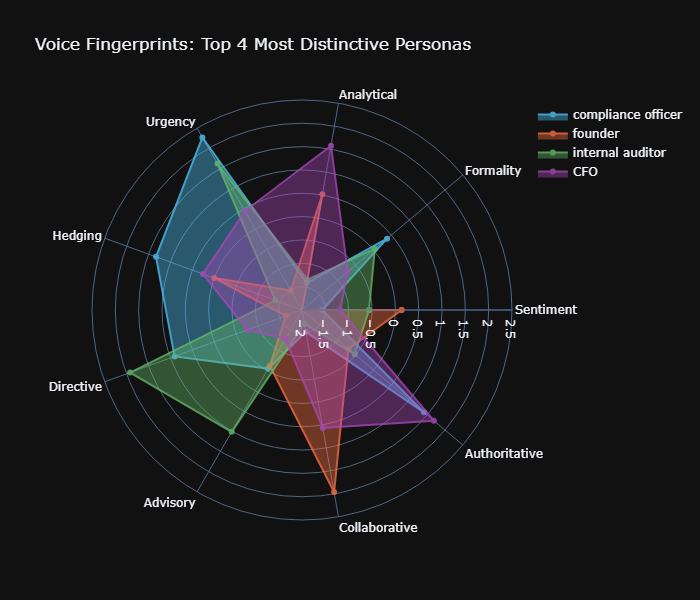
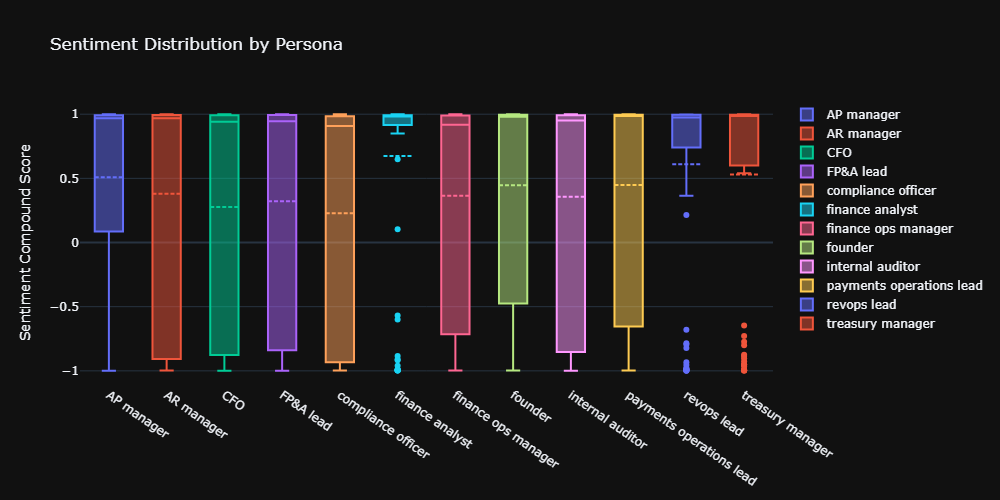
    Figure 4: Voice Fingerprints for Top 4 Distinctive Personas. The AI adopts entirely different structural shapes for different roles, heavily over-indexing on Urgency for Compliance Officers and Directive language for Internal Auditors.
    Figure 4: Voice Fingerprints for Top 4 Distinctive Personas. The AI adopts entirely different structural shapes for different roles, heavily over-indexing on Urgency for Compliance Officers and Directive language for Internal Auditors.
    Figure 5: Sentiment Distribution by Persona. Risk-averse roles (Compliance, Finance Ops) trigger wide, negative sentiment spreads, while generalist roles (Finance Analyst) remain tightly clustered and neutral.
    Figure 5: Sentiment Distribution by Persona. Risk-averse roles (Compliance, Finance Ops) trigger wide, negative sentiment spreads, while generalist roles (Finance Analyst) remain tightly clustered and neutral.

    Do AI Search Queries Differ by Persona Too?

    AI search engines don’t just generate different answers—they execute different background searches depending on who’s asking.

    Query fan-out similarity results:

    • Original queries: +0.054 within-persona gap (p = 0.002), r = 0.23
    • Ablated queries: +0.036 gap survives (p = 0.002)
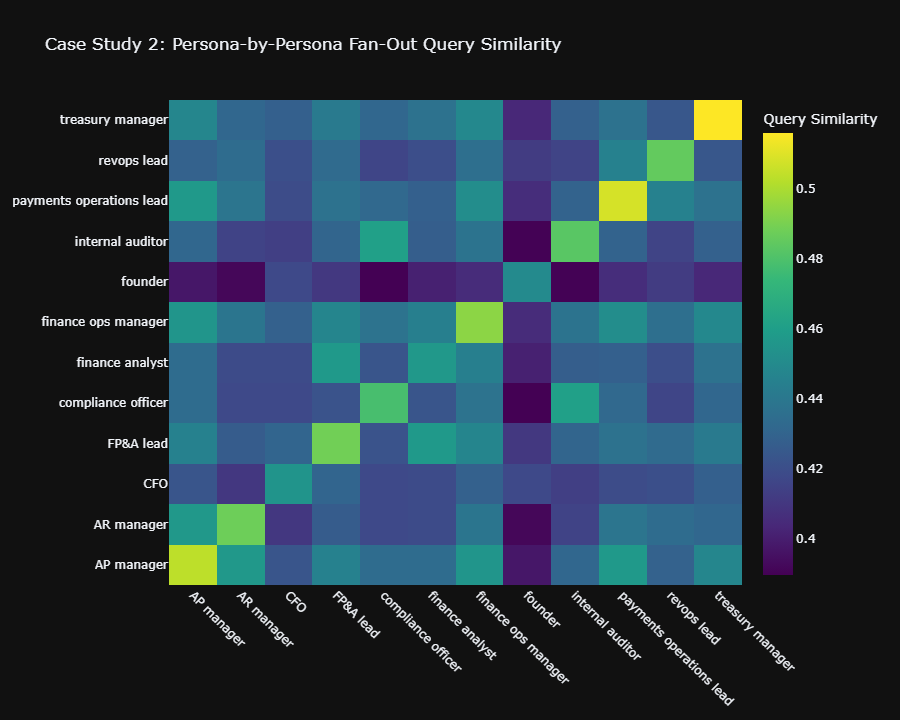
    Figure 6: Fan-Out Query Similarity Heatmap. The bright yellow diagonal line proves that the AI formulates highly similar background search queries when the persona is identical.
    Figure 6: Fan-Out Query Similarity Heatmap. The bright yellow diagonal line proves that the AI formulates highly similar background search queries when the persona is identical.

    Translation: The AI reformulates search queries differently for different roles, retrieving distinct source material before generating responses. This suggests persona adaptation occurs at the retrieval layer, not just generation.


    3 AEO Tactics Based on This Research

    1. Prioritize Operational Roles for Persona Targeting

    AR managers, AP managers, and payments ops leads trigger the strongest AI differentiation. Build dedicated content streams for these roles with specific operational metrics and workflow context.

    2. Use Industry/Use-Case Differentiation for Generalists

    Finance analysts show weak persona signal. Instead of role-based content, target this ICP through industry vertical expertise (SaaS financial operations, healthcare revenue cycle) and specific use cases (month-end close automation, board reporting).

    3. Match Register to Role Expectations

    AI adapts tone significantly by persona. Your content should mirror:

    • Formal, analytical register for FP&A and treasury
    • Urgent, risk-aware framing for compliance and audit
    • Collaborative, strategic tone for founders and CFOs
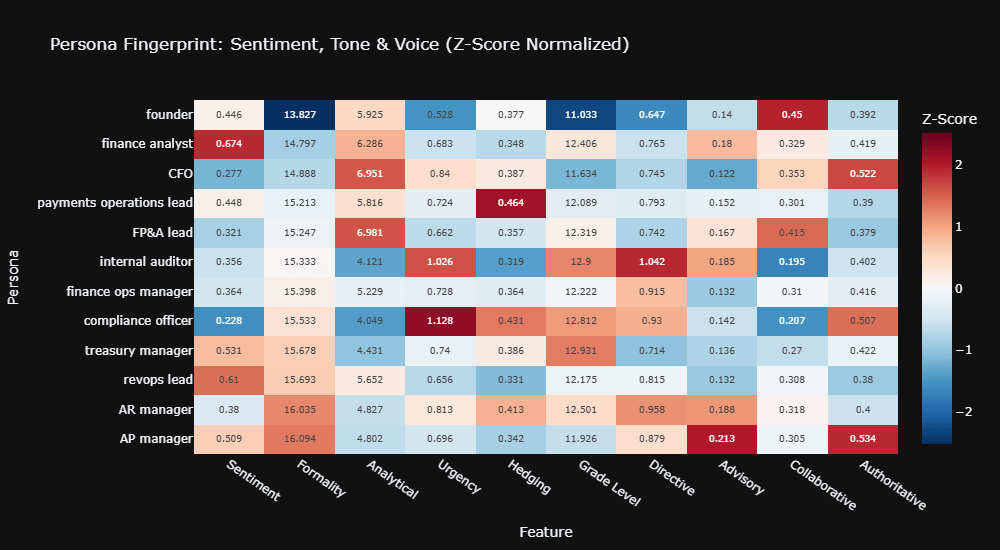
    Figure 7: Normalized Heatmap of Sentiment, Tone & Voice. A visual guide for AEO: match your content's register to the dark red (over-indexed) and dark blue (under-indexed) areas the AI expects for your target persona.
    Figure 7: Normalized Heatmap of Sentiment, Tone & Voice. A visual guide for AEO: match your content’s register to the dark red (over-indexed) and dark blue (under-indexed) areas the AI expects for your target persona.

    How to Optimize Content for AI Persona Targeting

    Do:

    • Include specific operational metrics relevant to the role (DSO for AR, days payable outstanding for AP)
    • Structure content around role-specific priorities (runway protection for CFOs, retention balance for AR managers)
    • Use industry-standard terminology naturally—AI recognizes professional vocabulary as context signals

    Don’t:

    • Over-optimize for generic “finance” personas—weak differentiation signal
    • Rely solely on job title mentions—72% of effect is substantive
    • Ignore confidence intervals—finance analyst targeting shows high uncertainty (d = 0.48 ± 0.32)

    Methodology: How We Measured AI Persona Effects

    ComponentSpecification
    Sample size988 responses
    Personas12 B2B finance roles
    Topic clustersCash flow, payment processing, fraud detection
    Statistical testBlocked permutation test (persona shuffled within topic×intent blocks)
    Permutations500 overall, 200 per persona
    Ablation methodRegex removal of role vocabulary, names, jargon; re-embedding
    Similarity metricCosine similarity (OpenAI text-embedding-3-small)
    Tone analysisVADER (sentiment), Flesch-Kincaid (grade level), keyword density, imperative/modal ratios
    Significance testingPermutation p-values, Kruskal-Wallis H-tests with Bonferroni correction

    Limitations: Confidence intervals estimated via standard error approximation; individual persona samples (~82 responses) limit precision for smaller effects; query fan-out infers search behavior from query similarity rather than direct search log access.


    Bottom Line for AEO Strategy

    AI search engines do treat professional personas differently—but the effect is strategically meaningful, not dominant. Persona explains roughly 5% of response variance, with 72% of that signal coming from substantive content adaptation rather than vocabulary matching.

    High-confidence targeting: Operational finance roles (AR, AP, payments, treasury) Low-confidence targeting: Generalist roles (finance analyst) Primary optimization priority: Topic relevance and intent alignment remain more important than persona tailoring


    Research Context

    Research by: Kojable
    Tools: Google Gemini (grounding), OpenAI Embeddings, Python (NumPy, SciPy, Plotly, VADER)


    Key Terms: Understanding the Data

    To fully grasp how AI adapts to different personas, it helps to understand the statistical methods used to measure it. Here is how we define our core metrics:

    • Ablation (in AI Prompt Testing): In natural language processing, ablation is the process of intentionally removing specific variables to see how the system’s output changes. In this study, ablation meant mathematically stripping all role names, job titles, and industry jargon (e.g., “collections velocity”) from the AI’s responses. This allowed us to measure if the AI was actually changing its underlying advice, or just echoing back vocabulary.
    • Cohen’s d (Effect Size): Cohen’s d is a statistical metric used to measure the standardized size of a difference between two groups. In the context of Answer Engine Optimization, it tells us how intensely the AI differentiates its answers for a specific role. A score below $0.5$ is a weak/medium effect, while a score above $0.8$ (like the AR Manager’s $d = 0.95$) represents a massive, highly distinct variation in how the AI treats that persona.
    • Blocked Permutation Test: A rigorous statistical test used to prevent false positives. Instead of just scrambling all the data randomly, we shuffled the persona labels only within their specific topic and intent categories. This ensures that any differences we found were strictly driven by the persona, not because the AI was answering a completely different type of question.
    • Cosine Similarity: A metric used to measure how semantically similar two pieces of text are, regardless of their length. We used OpenAI embeddings to calculate the cosine similarity of the AI’s responses, proving mathematically that responses generated for the exact same persona cluster closer together than responses for different personas.

    Related Questions

    How much of AI personalization is real versus vocabulary echoing? 72% of persona signal survives complete vocabulary ablation, proving the AI adapts substantive advice structure, not just word choice.

    Which B2B roles trigger the most distinctive AI search results? Operational specialists (AR managers, payments ops leads) show very large effect sizes (d > 0.8). Strategic roles (CFOs, founders) show medium-large effects. Generalists (finance analysts) show weak, uncertain differentiation.

    Is persona-based content optimization worth the investment? Yes for operational roles with specific workflows and metrics; no for generalist roles where industry and use-case targeting outperforms persona targeting.

  • Reduce LLM prompt monitoring costs by 85%

    TL;DR

    Want to reduce LLM prompt monitoring costs without losing brand visibility in AI answers? We generated 180 finance-domain prompts across 3 topic clusters. We ran them through Google Gemini with live Google Search grounding. Then we measured how similar the AI’s responses and search queries were.

    The results were striking:

    • Similar prompts produce near-identical responses. r = 0.878. Bootstrap confidence interval confirms significance.
    • Similar prompts trigger similar grounding searches. r = 0.869. Mantel permutation test p is less than 0.001.
    • The implication: Companies can reduce AEO monitoring costs by approximately 85% by tracking seed prompts instead of every variation.

    The Problem: AEO Is Expensive

    Answer Engine Optimization is becoming critical for B2B companies. But it has a scaling problem.

    Unlike traditional SEO, where you optimize pages and track rankings for a defined keyword set, AEO requires monitoring how AI systems respond to natural-language prompts. And those prompts are infinite.

    “What is the best cash flow software for B2B SaaS?”

    “Top cash flow tools for mid-market companies”

    “How does cash flow forecasting work for fintech lenders?”

    “Cash flow management platforms with NetSuite integration”

    Each could trigger different AI responses, different grounding searches, and different brand mentions. Track them all individually and costs scale linearly. For a company monitoring 500 plus prompts across multiple AI platforms, this becomes unsustainable.

    The question we set out to answer: Can you track one prompt and confidently infer what the AI would say for dozens of similar prompts?

    Research Design

    Two hypotheses:

    1. AI Output Similarity. Do semantically similar prompts produce semantically similar AI responses?
    2. Fan-Out Query Similarity. Do similar prompts trigger similar grounding searches?

    If both are true, companies can consolidate prompts into clusters and monitor only representative seed prompts. Dramatically reducing cost and workload.

    Methodology

    We designed a controlled experiment with three distinct topic clusters in B2B finance:

    Cash Flow. Base queries on free cash flow and cash flow forecasting. Example: “free cash flow explained for B2B SaaS”

    Payment Processing. Base queries on B2B payment automation and cross-border payments. Example: “best cross-border payments tools with Stripe”

    Fraud Detection. Base queries on transaction fraud detection and AML compliance. Example: “how AML compliance works for a compliance officer”

    Each cluster contained 60 prompts. 180 total. Generated from 60 templates that varied across 7 context dimensions drawn from real B2B finance scenarios:

    • Personas: CFO, FP&A lead, treasury manager, AR manager, controller
    • Industries: B2B SaaS, fintech lender, payments platform, credit unions
    • Geographies: Ireland, US, UK
    • Integrations: NetSuite, Xero, SAP, Stripe, QuickBooks, Sage, HubSpot
    • Company sizes: SMB, mid-market
    • Time periods: daily, weekly, monthly, quarterly
    • Metrics: runway, DSO, DPO, burn rate, working capital, net revenue retention

    Prompts ranged from 6 to 20 words. Mixed styles including questions, commands, fragments, and phrases to simulate realistic user behavior.

    Measurement

    All 180 prompts went to Google Gemini 3.0 Flash with grounding enabled. For each prompt we captured:

    • The AI’s full text response
    • The grounding search queries the AI generated
    • The grounding source URLs and titles

    We computed semantic similarity using Gemini Embedding-001. Not TF-IDF. This captures meaning, not just word overlap. TF-IDF would score “money” and “capital” as zero percent similar. Embeddings correctly identify them as semantically close.

    All similarity scores used cosine similarity on L2-normalized embedding vectors.

    Results

    Case Study 1: AI Output Similarity

    Do similar prompts produce similar responses?

    Yes. With extremely strong evidence.

    The Pearson correlation between prompt similarity and response similarity was r = 0.878. This means 77% of the variance in response similarity is explained by prompt similarity alone.

    To put this in context:

    • r = 0.3 would be interesting but weak
    • r = 0.5 would be moderate, worth investigating
    • r = 0.878 is near-perfect linear relationship

    Control Group Validation

    We verified our measurement using within-cluster versus cross-cluster comparisons:

    • Within-cluster response similarity, same topic: 0.664
    • Cross-cluster response similarity, different topics: 0.569
    • Cohen’s d: 1.27, classified as very large effect

    The AI clearly distinguished between topics. Cash flow prompts produced cash flow answers. Fraud prompts produced fraud answers. This confirms our embeddings capture real semantic differences, not noise.

    Case Study 1 – AI Output Similarity. Left: Prompt similarity vs response similarity (r=0.878). Middle: Distribution of all response similarities. Right: Within-cluster responses are more similar than cross-cluster responses (difference +0.066, 95% CI [0.066, 0.077]).
    Case Study 1 – AI Output Similarity. Left: Prompt similarity vs response similarity (r=0.878). Middle: Distribution of all response similarities. Right: Within-cluster responses are more similar than cross-cluster responses (difference +0.066, 95% CI [0.066, 0.077]).

    Addressing Statistical Rigor

    A naive t-test on 16,110 pairs would report t = 77.7, p approximately 0. But this is pseudoreplication. Each prompt participates in 179 pairs, violating the independence assumption.

    We addressed this with a stratified prompt-level bootstrap. Two thousand iterations. Resampling prompts within each cluster to maintain balance and respect the dependence structure:

    • Observed difference, within minus cross: plus 0.066
    • 95% Bootstrap CI: [0.064, 0.078]
    • Interpretation: The CI does not include 0. The effect is robust to prompt-level dependence.

    Case Study 2: Fan-Out Query Similarity

    Do similar prompts trigger similar grounding searches?

    Yes. Also with strong evidence.

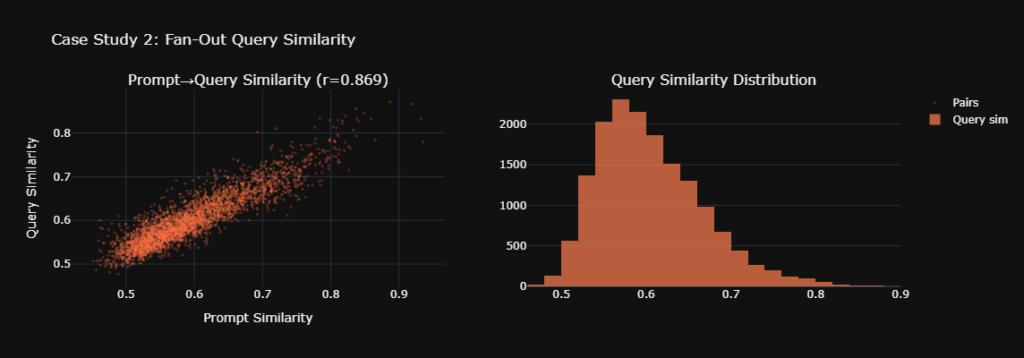
    The 180 prompts triggered 1,620 unique grounding searches. Approximately 9 per prompt. The correlation between prompt similarity and query-set similarity was r = 0.869.

    Fan-Out Query Similarity. Left: Prompt similarity vs query similarity (r=0.869). Right: Distribution of query similarities across all prompt pairs
    Fan-Out Query Similarity. Left: Prompt similarity vs query similarity (r=0.869). Right: Distribution of query similarities across all prompt pairs

    We used a symmetric best-match average to handle variable fan-out sizes. Some prompts triggered 5 searches, others 15. This prevents larger query sets from mechanically appearing more similar due to size alone.

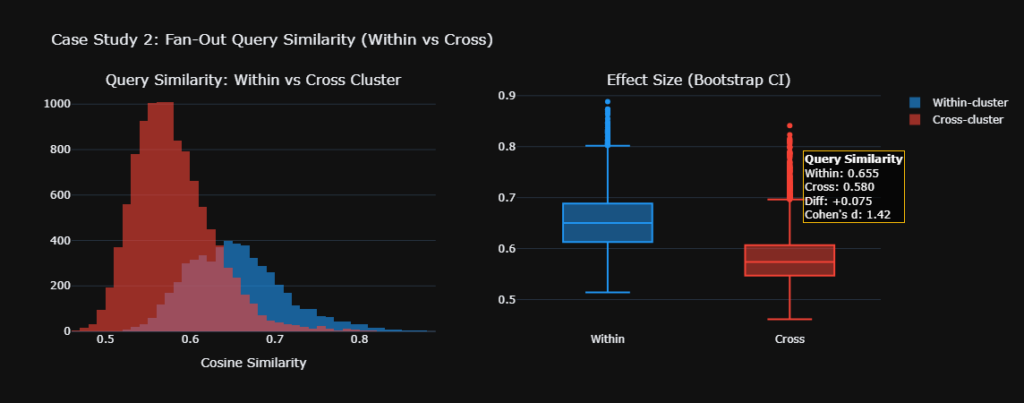
    Within vs Cross-Cluster Query Similarity. Within-cluster queries are substantially more similar (0.655) than cross-cluster queries (0.580), with a large effect size (Cohen's d = 1.42)
    Within vs Cross-Cluster Query Similarity. Within-cluster queries are substantially more similar (0.655) than cross-cluster queries (0.580), with a large effect size (Cohen’s d = 1.42)

    Statistical significance was confirmed via a Mantel permutation test. Two thousand permutations. This accounts for the matrix dependence structure. The empirical p-value was less than 0.001. Zero out of 2,000 random permutations matched or exceeded the observed correlation.

    Grounding Source Analysis

    We examined the titles of grounding sources across clusters:

    • Over 80% of source titles were unique to a single topic cluster
    • Cash flow prompts cited cash flow-specific resources. Fraud prompts cited fraud-specific resources
    • Only generic finance portals like Investopedia appeared across multiple clusters
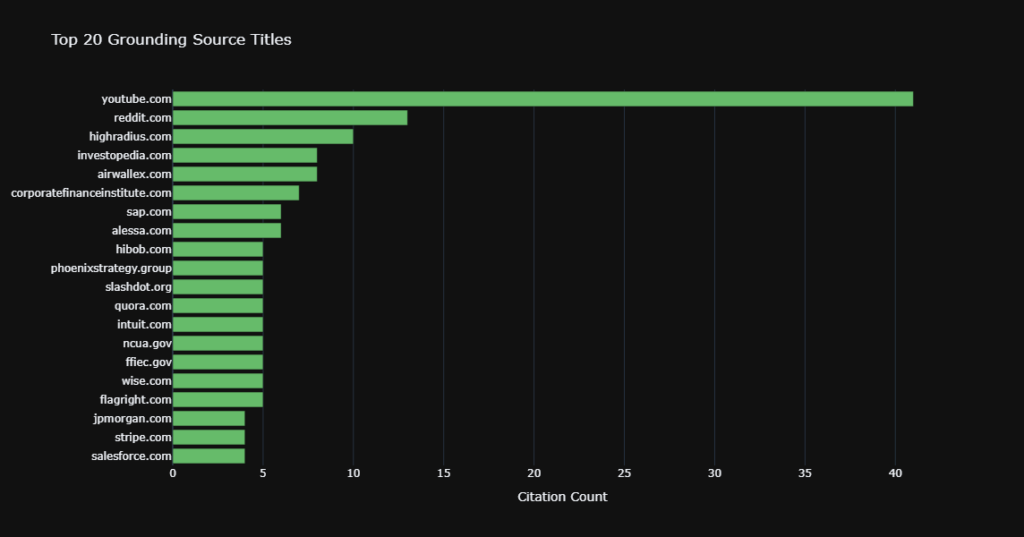
    Top 20 Grounding Source Titles. YouTube dominates, followed by Reddit and topic-specific vendor/reference sites

    This high specificity means the AI is not lazily citing the same sources for everything. It’s performing targeted, topic-aware retrieval.

    What This Means for AEO Strategy

    1. Prompt Consolidation: Track Seeds, Not Everything

    The core finding, r = 0.878, means you can group prompts by semantic similarity and track only one seed prompt per group.

    Before consolidation: Track 500 prompts. 500 API calls per day. High cost.

    After consolidation: Cluster prompts using cosine similarity greater than 0.75 threshold. Track approximately 50 to 75 seed prompts. 85% cost reduction.

    The seed prompt’s response can be confidently extrapolated to the entire cluster.

    2. Brand Mention Extrapolation

    If your brand appears or doesn’t appear in the response to a seed prompt, you can infer the same for all prompts in that cluster. Response similarity of 0.70 within a cluster means the structure, content, and likely brand ordering are preserved across variations.

    3. Fan-Out Query Coverage

    Instead of optimizing content for every possible grounding query, focus on the top 10 to 15 grounding queries per topic cluster. Since similar prompts trigger overlapping searches, addressing one prompt’s grounding queries provides coverage for the entire cluster.

    The math: 180 prompts generated 1,620 queries. But within a cluster, the top 15 queries cover the vast majority of search behavior. Optimizing for 45 queries, 15 times 3 clusters, is far more efficient than optimizing for 1,620.

    4. Content Architecture

    The source title specificity, over 80% unique per cluster, tells you that generic catch-all content pages won’t work for AEO. The AI prefers topic-specific, authoritative content.

    Don’t: Write one giant “Complete Guide to B2B Finance”

    Do: Write dedicated pillar pages. “Cash Flow Forecasting for B2B SaaS”. “Cross-Border Payment Automation Guide”. “AML Compliance Checklist for Fintech”. Each pillar page should target the top grounding queries for its cluster.

    Limitations and Future Work

    What we didn’t test:

    1. Brand mention rank correlation. We measured overall response similarity but didn’t extract and compare the specific order in which brands are mentioned. A follow-up using Kendall’s tau on brand rankings would strengthen the consolidation argument.
    2. Temporal stability. Our data represents a single point in time. Running the same seeds weekly for 4 to 8 weeks would confirm whether the r = 0.878 relationship holds as the AI model updates.
    3. Cross-model consistency. This study used Google Gemini. Testing with ChatGPT with Bing grounding, Perplexity, and Claude would determine whether consolidation strategies transfer across AI platforms.
    4. Domain breadth. All prompts were in B2B finance. The consolidation ratio may differ for other verticals like healthcare, legal, or e-commerce.

    Methodological Notes

    • All statistical significance tests used dependence-aware methods. Prompt-level bootstrap and Mantel permutation test rather than naive pairwise tests.
    • Similarity was measured via neural embeddings, Gemini Embedding-001, not bag-of-words approaches.
    • Query-set similarity used symmetric best-match averaging to normalize for variable fan-out sizes.

    Conclusion

    This study provides strong, statistically robust evidence that similar prompts produce similar AI responses and trigger similar grounding searches. The practical implication is clear: AEO does not require tracking every conceivable prompt variation.

    By clustering prompts semantically and monitoring representative seeds, companies can achieve comprehensive AEO coverage at a fraction of the cost. The data suggests an 85% reduction in monitoring workload is achievable without sacrificing insight quality.

    For AEO practitioners, the message is simple: Work smarter, not harder. One prompt can represent many.


    This research was conducted by Kojable as part of our ongoing work in Answer Engine Optimization. The full methodology, code, and data are available on request.

    Tools used: Google Gemini 3.0 Flash with grounding, Gemini Embedding-001, Python with NumPy, SciPy, Plotly, and scikit-learn.

  • What G2 Data Reveals About the GEO/AEO Tool Landscape?

    I analyzed G2 data for 23 AEO platforms to see who is really buying, using, and reviewing these tools. Here’s what the numbers reveal about market saturation, persona dominance, and whitespace opportunities.

    1) Market segment: where the fight is hottest

    The Small-Business segment is crowded, with many competitors showing 60%+ SB concentration. Some vendors are entirely SB-dependent: Visby AI (91%), Hall (92%), AI clicks (88%), SE Ranking (89%), and even major names like Semrush (62%) and Ahrefs (62%).

    Implication: If you’re launching an AEO tool for small businesses, you’re entering the most saturated segment. To win, you need extreme ease-of-use (self-serve, zero onboarding), aggressive pricing (freemium or sub-$99/mo), or a hyper-specific niche like “AEO for local service businesses.” Generic “AI visibility for SMBs” won’t cut it.

    At the Enterprise end (35%+ concentration), fewer players compete, and a smaller group balances Enterprise/Mid-Market. This split creates distinct “lanes” (SMB-first, MM-first, Enterprise-first), each with different expectations for onboarding, security/compliance, reporting depth, and customer success.

    2) Personas: practitioners dominate, but execs are emerging

    The most frequently targeted roles skew toward SEO and marketing practitioners:

    • SEO Manager (5 vendors)
    • Marketing Manager (4 vendors)
    • Digital Marketing Manager / SEO Specialist (2 each)

    However, CEO/Founder/Owner appear as primary users for Profound, Visby AI, Ahrefs, and SE Ranking—suggesting these tools are either simple enough for non-specialists or packaged as high-level strategic reporting.

    Implication: Most platforms are built for doers (SEO teams executing daily). But there’s a second motion: dashboards so clean that a CEO can answer “Are we visible in AI search?” in 30 seconds. Serving both personas unlocks budget authority and daily stickiness. If your product requires expert workflows, lean into “built for practitioners.” If it’s narrative/visibility risk + decision support, position it as “built for leadership.”

    3) Industry focus: concentration creates whitespace

    70% of competitors focus on Marketing & Advertising (12 vendors), Computer Software (6 vendors), and IT Services (3 vendors). This density provides clear ICP fit but also creates opportunities where competitive noise is lower.

    Underserved industries:

    • Financial Services (only Yext)
    • Healthcare (only Yext)
    • Retail (3 vendors, not primary)
    • Consumer Services (only Conductor)

    Implication: An AEO platform specifically built for regulated industries (Finance, Healthcare, Legal) or product-heavy sectors (Retail, CPG) would face minimal direct competition. The wedge: “We understand your compliance needs / product catalog structure / seasonal volatility.”

    4) The biggest insight: a major data gap

    A meaningful portion of competitors have “No information available” for Users (and some for Industries). This creates strategic risk—conclusions about persona saturation and category positioning become biased toward companies with better-populated profiles.

    Action item: Fill these gaps with external research: product pages, case studies, job postings, sales decks, onboarding flows, customer logos, and review mining beyond G2 snapshots.

  • AEO/GEO Pricing Intelligence: What You Can Afford to Pay

    A vendor manager’s guide to AI Search Optimization budgets, ROI thresholds, and platform selection


    The Bottom Line for Budget Owners

    If you’re managing AEO/GEO vendor selection, here’s your decision framework: Don’t pay more than you can justify in measurable search visibility ROI within 12 months.

    With platforms now competing across freemium to custom enterprise tiers, overpaying is a bigger risk than underpowering.

    Current Entry Floor: $39–$99/month
    ROI Justification Zone: $150–$399/month for most mid-market organizations
    Enterprise Threshold: $500+/month only if you have multi-brand complexity or compliance requirements


    Budget Tier Analysis: What You Get vs. What You Should Pay

    Tier 1: Proof-of-Concept / Solopreneur ($0–$99/month)

    Who should buy: Startups validating AEO need, individual consultants, agencies testing tools for client recommendations

    Price PointWhat to ExpectROI RealityExample Vendors
    Free–$491–2 AI engines, basic tracking, 1 projectBreak-even on time savings onlyAirOps (start for free),
    Hall Lite (free, 1 project), Geneo (free tier + Pro at $39.9),
    Geordy (entry usage-based credits)
    $50–$992–4 engines, 5–10 articles/month, competitor monitoringJustifiable if it saves 2–3 hours/week of manual search auditingWritesonic Lite ($49), Jasper Pro ($59),
    Cognizo Monitor ($89), Promptwatch Starter ($99),
    Profound Starter ($99),
    Scrunch Explorer ($100)

    Vendor Manager Play: Treat this as a trial tier. If a vendor can’t demonstrate measurable visibility lift within 60 days at this price, they won’t deliver at higher tiers.

    Red flag: Any platform without content generation bundled here will be obsolete by Q4 2026.

    Freemium Risk Warning: AirOps and Hall Lite offer unlimited free tiers—sustainable only if 5–10% convert to paid. If you’re staying on free forever, expect feature limits or sunsetting.


    Tier 2: Departmental Deployment ($150–$399/month)

    Who should buy: Marketing teams at $5M–$50M revenue companies, growth agencies managing 3+ clients

    This tier is the most saturated segment. Differentiation is non-technical (support quality, onboarding, agent features).

    Price PointJustification MathRisk AssessmentExample Vendors
    $150–$199Must deliver equivalent of 1–2 days/month of analyst time savings + measurable ranking improvementsHigh churn zone—vendors compete on features, not outcomesOtterly Standard ($189), AIclicks Pro ($189),
    Hall Starter ($199), Writesonic Professional ($249)
    $200–$299Should include content automation, multi-engine coverage, team collaboration (3+ seats)Sweet spot for ROI—platforms here have enough functionality to show real workflow impactPromptwatch Professional($249),
    $300–$399Requires either: (a) execution agents, (b) compliance features, or (c) agency-level multi-client managementIf it doesn’t include agents/automation, you’re overpayingGeordy Business ($399)
    Profound Growth ($399),
    Cognizo Optimize ($399),
    Open Forge Startups($349)

    Critical Insight: At $200–$299, switching costs become your friend. Once a team is trained and data is accumulated, migration pain exceeds the savings from downgrading to a $99 competitor. Negotiation leverage: Push for annual prepay discounts (typically 15–20%—Hall offers 16%, AIclicks 17%, Writesonic 20%).


    Tier 3: Enterprise / Multi-Brand ($500–$12,000+/month)

    Who should buy: Enterprise brands with complex governance, regulated industries, agencies managing 10+ clients

    Price PointWhen It’s JustifiedWhen It’s NotExample Vendors
    $500–$799Self-serve enterprise with unlimited seats, API access, custom reportingIf you need heavy customization but the vendor charges for “managed services” without delivering strategic valueTelepathic Pro ($475),
    AIclicks Business ($499),
    Scrunch Growth ($500),
    Promptwatch Business ($549),
    Share of Model ($799)
    $1,000–$3,499Custom integrations, dedicated success management, outcome-based pricingPure monitoring with a high price tag—platform features will commoditize this within 18 monthsOpen Forge Midmarket ($1,999),
    Yolondo Growth ($3,499)
    $3,499–$10,000+Done-for-you execution, guaranteed rankings, agency staffing augmentationYou’re paying for labor, not software—benchmark against hiring in-house talentOpen Forge Managed ($3,999),
    Alex Groberman Enterprise ($9,999),

    Vendor Manager Rule: Above $1,000/month, demand published case studies with comparable companies.

    Platforms like ChatRank, SaaSRank and Withgauge hide pricing—this creates procurement friction and often signals sales-driven complexity rather than value clarity.


    Pricing Model Selection for Procurement

    Your GTM StrategyBest Pricing ModelWhy It WorksVendors Using This Model
    Organic growth, limited budgetTransparent flat-ratePredictable costs, no overage surprises, easy budget approvalHall (16% annual discount),
    Cognizo (17%, 2 months free),
    Rapid scaling, uncertain usageFeature-led hybridFlexibility, but requires strict usage monitoring to avoid budget creepAIclicks (hybrid: engines + blogs + prompts), Writesonic (articles + seats + GEO), Promptwatch (sites + prompts + articles), Scrunch (users + prompts),
    ZipTie (searches + optimizations),
    Otterly (prompts + audits), Geordy (usage-based credits),
    Geneo (credit-based)
    Enterprise sales, complex requirementsCustom/Outcome-basedAligns vendor incentives with your results, but requires robust SLA definitionsOpen Forge Managed, Alex Groberman Labs, SaaSRank, Petra Labs, Share of Model, Withgauge, ChatRank

    Procurement Warning: Hybrid models often create “overage shock” at month-end.

    AIclicks, Writesonic, Promptwatch, Scrunch, and ZipTie all use multi-dimensional pricing—cap monthly spend or negotiate unlimited tiers if you have variable content needs.

    Geordy and Geneo use credit-based systems that require careful burn monitoring.


    ROI Calculation Framework for Vendor Managers

    Use this formula to determine your maximum justifiable spend:

    Monthly Platform Cost ≤ (Monthly Value of Time Saved) + (Estimated Revenue Impact from Visibility Gains)

    Component A: Time Savings Valuation

    • Manual AI search auditing: 4–8 hours/week for a mid-market brand
    • Loaded cost of marketing analyst: $75–$125/hour
    • Monthly value of automation: $1,200–$4,000

    Component B: Revenue Impact

    • Conservative: 5–10% increase in qualified organic traffic from AI search
    • Average B2B conversion rate: 2–3%
    • Average deal size: Calculate your own

    Example Calculation

    If a platform saves 6 hours/week of analyst time ($4,500/month value) and generates 2 additional qualified leads worth $5,000 each:

    Maximum Justifiable Cost: $4,500 + $10,000 = $14,500/month
    Rational Ceiling for AEO Platform: $500–$1,000 (you’re paying for software, not total value capture)


    Vendor Differentiation by Use Case

    Instead of repeating the same names, here’s how specific platforms carve out positioning:

    Use CaseExample VendorsWhy Them
    Content-heavy teamsWritesonic (40–100 articles), AIclicks (10–30 blogs), Promptwatch (5–30 articles)Quantity + quality of AI-generated content bundled
    Execution agents (auto-publishing)Telepathic (AI strategy agent),
    Open Forge (unlimited agent usage)
    Automation beyond monitoring
    Agency multi-client managementHall Business (50 projects), Scrunch Growth (5 users, 700 prompts),
    Promptwatch Scale (5 sites, 350 prompts)
    Seat scaling + project segmentation
    Startup-friendly entryGeneo ($39.9 affordable multi-brand),
    ZipTie Starter ($69)
    Low friction, growth-path clarity
    Enterprise service-heavyOpen Forge Managed,
    SaaSRank,
    Alex Groberman Labs,
    Petra Labs
    Done-for-you execution, but verify outcome guarantees

    Market Trajectory: Lock in Pricing Now

    2026 Forecast:

    Monitoring will become table stakes, differentiation will shift to execution agents.

    Strategic Recommendation:

    • If buying in Q1–Q2 2026: Lock annual contracts at current $150–$250 rates.
    • Platforms like Hall, AIclicks, and Writesonic offer 16–20% annual discounts—you won’t see lower mid-market prices, and feature expansion will make these tiers more valuable.
    • If evaluating vendors: Prioritize platforms with agent/automation roadmaps (Telepathic, and Open Forge). Pure monitoring plays (ChatRank, Peec.ai) will be commoditized within 18 months.
    • If managing existing contracts: Renegotiate any $500+ monitoring-only contracts immediately. That pricing reflects 2024 market conditions, not 2026 realities.

    What to Avoid (Across All Platforms)

    Don’t pay for:

    • Generic monitoring without content generation (below $300 tier).
    • Hidden pricing without clear ROI demonstrationWithgauge, Petra Labs all obscure costs; demand transparency or walk away
    • “Enterprise” features you can replicate with $50/month tools + Zapier

    Do pay for:

    • Execution agents that automate publishing/optimization (Telepathic, Open Forge)
    • Proven case studies in your exact company size/category

    The 2026 AEO market is a buyer’s market below $300 and a value-validation challenge above $500.

    With 195+ platforms competing, you have leverage—use it to lock in rates before the next pricing compression cycle.

  • The Reddit Myth in Fintech: Why AI SEO is not one-size-fits-all

    If you’re a fintech marketer, you’ve probably heard the advice: “Get active on Reddit to show up in AI search results.”

    Our data says that’s wasted effort. Here’s why.

    The “Reddit Everywhere” Myth

    If you follow Generative Engine Optimization (GEO), you’ve seen the narrative: User-Generated Content platforms dominate AI citations. Studies from Profound, Semrush, and BrightEdge show Reddit and YouTube command 20–40% of Google AI Overview citations.

    For broad consumer questions, that’s true. For fintech? The data tells a completely different story.

    The Fintech GEO Study: When Money Moves, AI Gets Serious

    We analyzed how Google Gemini actually cites sources in fintech—where regulatory compliance, security, and technical accuracy matter.

    The dataset:

    The results upend the conventional wisdom.

    Authority Trumps Popularity

    In general GEO studies, Reddit and YouTube dominate. In fintech, they’re barely present:

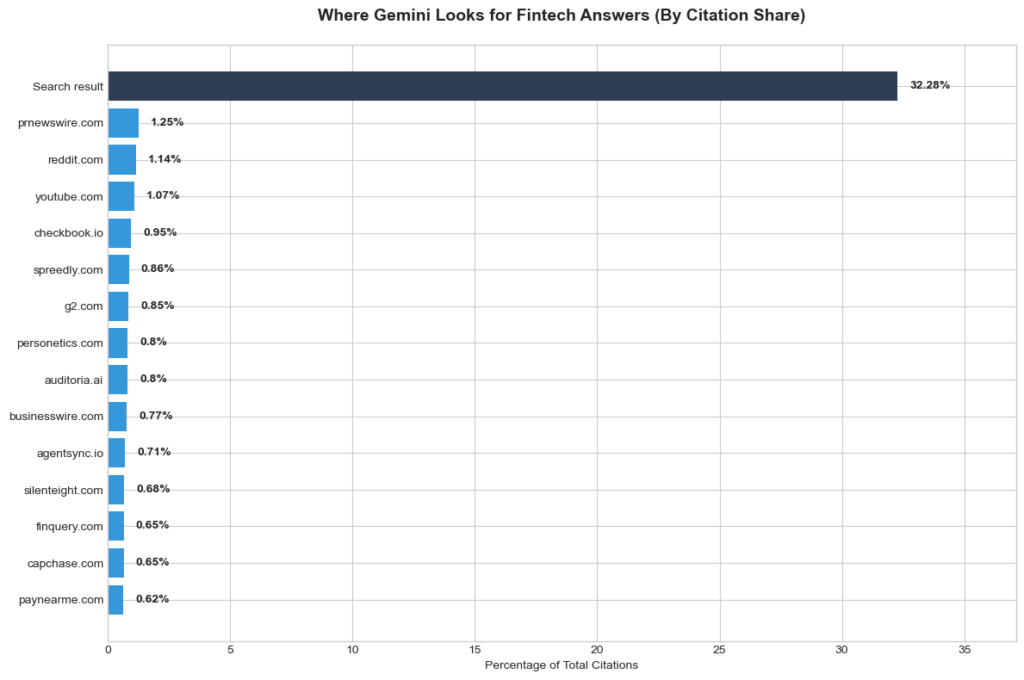
    • Reddit: 1.14% of citations
    • YouTube: 1.07% of citations

    For perspective: a single press release wire (PRNewswire at 1.25%) generated more AI citations than both combined.

    Generic platforms fared even worse:

    • Medium: 0.27%
    • Wikipedia: 0.21%
    • Quora: 0.13%

    Bottom line: When AI explains financial infrastructure, it doesn’t crowdsource from Redditors.

    Source titleFrequencyShare of all supports
    Search result2,17732.28%
    prnewswire.com841.25%
    reddit.com771.14%
    youtube.com721.07%
    checkbook.io640.95%
    spreedly.com580.86%
    g2.com570.85%
    personetics.com540.80%
    auditoria.ai540.80%
    businesswire.com520.77%

    Where Gemini Actually Looks

    1. It trusts itself first (32% of citations)
    The largest source was “Search result” meta-citations, confirming Gemini runs multiple background queries before answering. This makes your own website’s clarity more critical than ever.

    2. It trusts specialists (the long tail)

    First-Party Sources (your website): Company domains (checkout.com, wealthfront.com, stripe.com) appear frequently. AI goes straight to the source—if that source is clear and comprehensive.

    Vertical Media & Analysts: Fintech Futures, PYMNTS, Gartner, and industry analysts hold significant sway.

    B2B Review Platforms: G2, Trustpilot, and SourceForge feed AI recommendations with structured comparison data.

    The Strategic Pivot for Fintech Marketers

    Stop chasing the Reddit dragon. It’s low-leverage for fintech queries.

    Instead:

    1. Make Your Website an AI-Ready Knowledge Base

    • Publish detailed technical specifications with schema markup
    • Create comparison pages that differentiate you from 3-5 competitors
    • Update core pages quarterly (freshness signals matter)

    2. Target the Fintech Press That AI Actually Reads

    Digital PR should focus on:

    • Industry analysts (Gartner, Forrester)
    • Vertical publications (Fintech Futures, PYMNTS, The Financial Brand)
    • Podcasts and video interviews (transcripts become training data)

    3. Own Your Review Platform Presence

    G2 and Trustpilot aren’t just lead gen—they’re AI training data. Ensure your profiles are:

    • Complete with technical specs
    • Updated with recent customer reviews
    • Rich with category-specific tags

    4. Create Machine-Readable Differentiation

    AI can’t infer what you don’t state explicitly. Publish content that says:

    • “We’re the only [category] that [unique capability] for [specific customer]”
    • “Unlike [competitor], we [specific technical difference]”

    In fintech GEO, leverage doesn’t come from content volume. It comes from being the undeniable authority in the specific places AI looks for credible data.

    Your competitors are wasting time on Reddit. You can own the sources that actually matter.

    Methodology note: While our study focused on B2B fintech infrastructure, these principles apply across fintech verticals where accuracy and authority matter more than popularity.